
What to Expect from an FDM Print
FDM 3D printing offers many advantages – a wide material range, affordable pricing, fast prototyping – but it’s also important to have realistic expectations of what can be achieved with the technology.
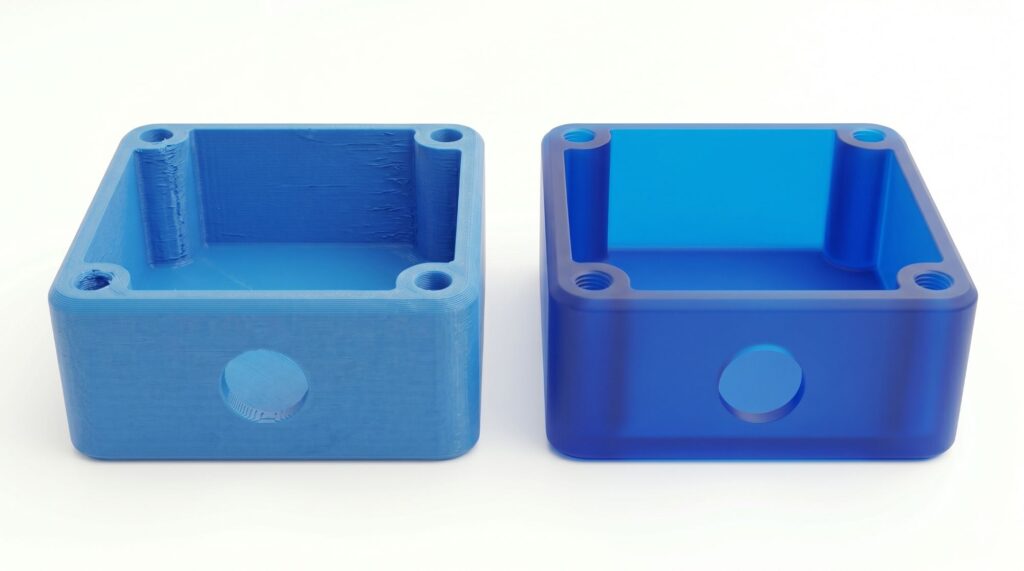
With Fused Deposition Modeling (FDM) 3D printing, a thermoplastic (e.g. PLA, PETG, ABS) is melted in a nozzle and laid down in a designated shape, layer by layer. Because of this process, overhanging parts over 45 degrees often require supports, which can lead to markings or visual defects.
Additionally, depending on the specific material, after the layer is deposited and the filament cools down, it can contract and affect the size of the print’s part; this is known as thermal contraction. This is important when printing threads or holes, especially if the project is composed of mating parts or assemblies.
While FDM can also provide significant detail – with layer lines as low as 0.08 mm – other technologies – such as resin-based SLA or DLP – can offer more suitable solutions, depending on your goals. Plus, FDM will also lead to visible layer lines that would have to be sanded – if possible, depending on the model – to achieve a smoother surface; this would be possible by default with other technologies.
When it comes to clarity, even though there are transparent filaments, because FDM models are printed layer by layer (oftentimes with infill), the piece itself is not fully transparent. There are post-processing options that can help achieve better results, such as sanding or polishing, but the layers themselves can still remain visible to some degree.
When it comes to strength, FDM prints are anisotropic – they aren’t equally strong in every direction. For example, heavy forces pulling directly perpendicular to the layer lines can cause delamination, or the separation of the layers. While careful print orientation can help mitigate this, projects that require true uniform, multi-directional strength – or isotropy – are better suited for powder-based SLS or resin-based SLA technologies.
Once you know whether FDM, SLA, or another additive manufacturing is more suitable for your project, you can upload your file at Craftcloud® and get an immediate quote to get started!