
Post-Processing Deep Dive: Bead Blasting vs. Tumble Polishing
Craftcloud® offers a range of manufacturing services, and among them, CNC machining enables you to create projects with a range of steels, engineering plastics, composites, and more. While many of these materials offer plenty from the start, post-processing can further increase their functionality, durability, and aesthetic finish. Bead blasting and tumble polishing are two of the most popular options – but when are they the right fit for your project?
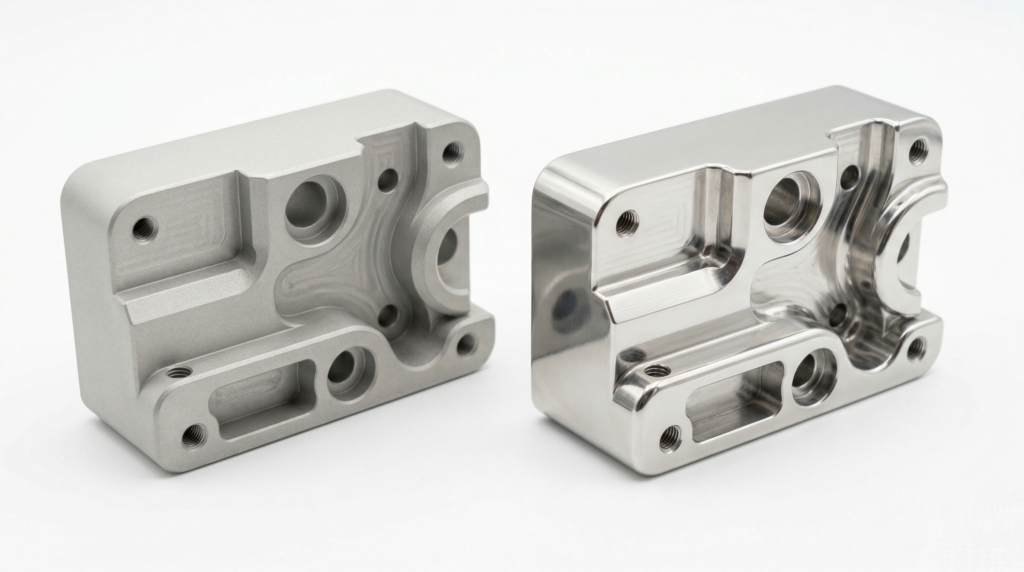
Bead Blasting
Bead blasting is used to create a uniform, matte, or satin texture. Most commonly, glass beads are propelled – blasted – against the part’s surface. This removes tool marks and burrs left by the machining process. While it affects the surface in that it removes the defects, it doesn’t significantly alter the part’s dimensions. Bead blasting can also be warranted if anodizing or powder coating are additional part of the process.
Depending on the material of the part – metals like aluminum or steel, softer options like copper or brass, or plastics like PEEK, PC, or acetal – the process itself has to change in terms of pressure and media. Otherwise, there is a risk of damaging the part or changing its dimensions.
Tumble Polishing
Tumble polishing allows smoothing, deburring, and polishing a large quantity of parts simultaneously. It involves placing the parts in a container filled with abrasives (e.g. ceramic, plastic, or steel shapes), along with water and chemical compounds. As the container moves – rotating or vibrating – the friction between the abrasives and the parts leads to the polishing of the surface and recessed areas.
Tumble polishing is used, along deburring, to achieve certain aesthetic and functional surface finishes, ranging from a soft matte to a high gloss. Additionally, by changing the type of abrasives and duration of the tumble cycle, parts can be prepared for additional processes, such as plating or painting.
As with bead blasting, depending on the type of material – hard or soft metals, plastics – the part’s weight and geometry will be defining factors regarding how the process is carried out. If the same abrasives are used indiscriminately, for example, plastic parts or softer metals can be damaged.
When to Use Which
Bead blasting can be the better choice for parts that need to have a non-reflective, professional look. The high-end, satin finish excels at hiding fingerprints and minor scratches. Bead blasting can also be a way of hiding directional tool marks, especially if the design has complex 3D surfaces where the marks are inconsistent or unappealing.
Tumble polishing would be more suitable where a large batch of small, complex parts need to be deburred, as doing so manually would be much more costly. It’s a post-processing option that also reduces friction in mechanical assemblies, since it can reduce the surface roughness of a part, and it can better smooth internal features than bead blasting. However, the abrasive media must be smaller than the part’s internal holes or slots to avoid becoming lodged inside.
Are you ready to upload your design to Craftcloud® and get started on your CNC machining project?