
Cancelled Orders: Wall Thickness Issues
When you design a model that will be created by additive manufacturing (e.g. 3D printing), an issue you may receive a notification on involves wall thickness.
Wall thickness refers to how thick the perimeter or shell of a 3D printed part is. It’s a crucial aspect of the design, as it can mean that the part will be sturdy and functional or that it will fall apart during printing (or soon after).
Depending on the specific 3D printing technology, a different wall thickness is warranted.
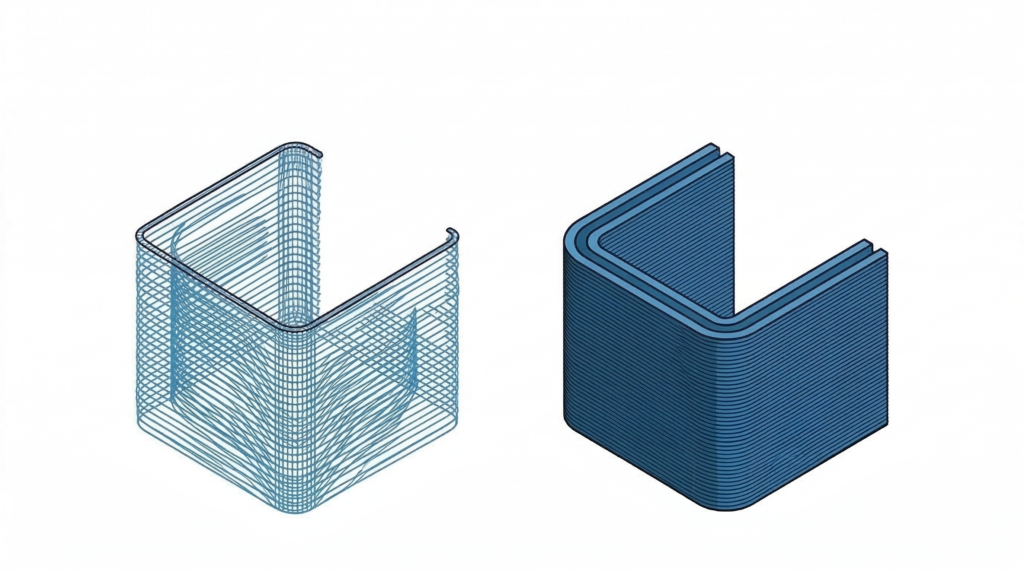
For Fused Deposition Modeling (FDM) printing, you might come across the terms “shell” or “perimeters”, depending on the slicer you’re working with. Each shell or perimeter (i.e. each time the nozzle completes a pass) can be determined by width in millimeters. It’s suggested that you use a multiple of the nozzle diameter for the wall thickness, but you’ll want to avoid blobs in the wall from too much extrusion (e.g. setting a 0.4-mm nozzle to 0.8-mm walls). A good option would be to set a 0.4-mm to 0.45-mm line width and opting for two walls, for a total of a 0.8-mm shell. As can be seen, the number of walls is also important. If you are 3D printing in transparent PETG, for example, a single wall (or “vase mode”) might yield the best visual results – but it will come at a cost in terms of resilience and durability of the part.
For Stereolithography (SLA), wall thickness is determined by the curing depth of the light source (laser or LCD) and the volume of the 3D model. It is generally suggested that you maintain a minimum wall thickness of 1.5 mm to 2.0 mm for structural parts to prevent warping or cracking during the post-curing process. The orientation of these walls is also critical; for example, if you are printing in a “Tough” or “Durable” resin, thin vertical walls might achieve high detail but can fail to support their own weight without sufficient internal scaffolding.
Selective Laser Sintering (SLS) allows for a minimum wall thickness as thin as 0.6 mm to 0.8 mm for small, non-load-bearing features. However, for functional durability and to prevent warping, a standard wall thickness of 1.0 mm to 1.5 mm is generally recommended.
For HP® Multi Jet Fusion (MJF) printing, wall thickness is a balance between structural integrity and thermal management during the cooling process. It is widely recommended to maintain a wall thickness of at least 1.0 mm to 1.2 mm for functional parts to ensure they don’t warp or become brittle. Large, thick sections (anything over 15 mm) should be avoided or “hollowed out” to prevent heat spots, which can lead to dimensional inaccuracies as the part cools.
In Direct Metal Laser Sintering (DMLS) or Selective Laser Melting (SLM), wall thickness is dictated by the intense thermal gradients generated as a high-powered fiber laser melts metal powder into a solid pool. Because metal is far more conductive and prone to internal stress than plastic, the minimum wall thickness is typically around 0.4 mm to 0.5 mm, though a thickness of at least 1.0 mm is recommended for structural stability. Thin walls are particularly susceptible to “thermal bowing” or warping as the metal cools and contracts, which can cause the recoater blade to crash into the part during the next layer.
You can find the minimum wall thickness required for the materials we offer in our Material Guide, in addition to additional tips in our Knowledge Base & Help Center and in an All3DP article. Once your model is ready, you can upload it and have it 3D printed at Craftcloud®!