
MJF vs. FDM
Multi Jet Fusion (MJF) and Fused Deposition Modeling (FDM) are two very different additive manufacturing technologies offered by Craftcloud®. One stands out for the versatility it allows for in terms of geometries, while the other can be very budget-friendly. Which one would be most suitable for your project?
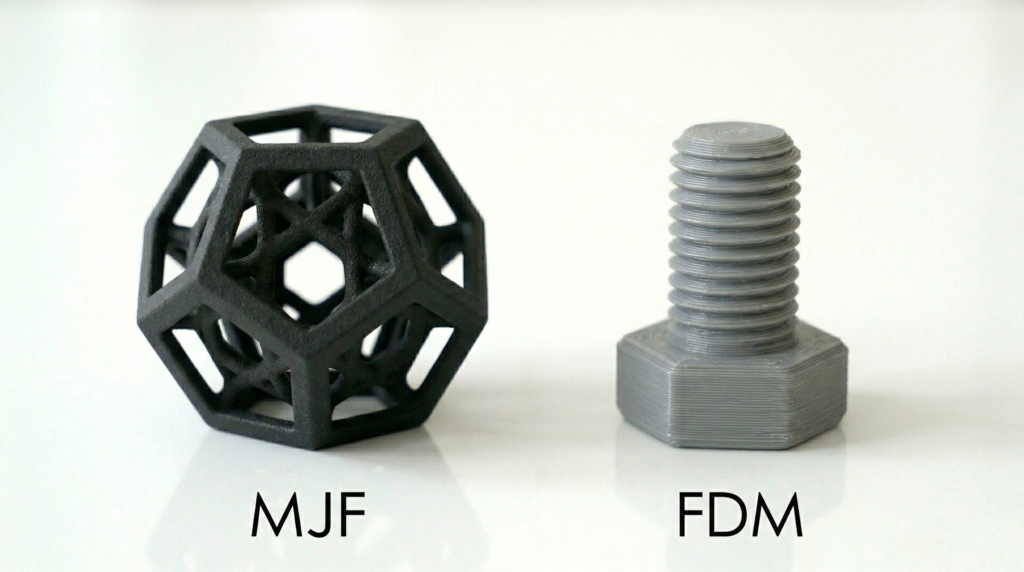
The Technologies in a Nutshell
MJF, developed by HP®, is an industrial 3D printing technology that uses a sweeping inkjet array to fuse plastic powder into solid parts. The process begins by spreading a thin layer of material across a build bed, after which a fusing agent is selectively applied to the cross-section of the part. High-power infrared lamps then pass over the bed to melt the areas treated with the agent, while a detailing agent ensures sharp edges and smooth surface finishes. Because the surrounding unsintered powder acts as a natural support, MJF allows for the creation of highly complex, interlocking geometries without the need for manual support structures.
FDM is an additive manufacturing process that builds objects by extruding melted thermoplastic filament (such as PLA, PETG, and ASA) through a heated nozzle. The hot end deposits this material layer-by-layer onto a build platform, where it quickly cools and fuses with the previous layer to form a solid object. Because of the process, depending on the design, it can require temporary support structures to hold up overhanging features. This technology is widely favored for its accessibility, low cost, and durability, making it the industry standard for functional prototyping and everyday household items.
MJF’s material range is specialized and more limited, although the complexity of the models it allows for is much higher. FDM’s material offer is much more varied both in terms of aesthetics and performance, but the designs can’t be produced with the same geometric freedom.
Best Use Cases
MJF is most suitable for:
- Ventures involving end-use functional parts
- Complex ducting and lightweight lattice structures
- Movable print-in-place mechanical assemblies (that need to be more resilient or durable than what FDM can provide)
FDM might be the better choice for:
- Rapid prototypes
- Custom figs, fixtures, and tooling
- Low-cost replacement parts
Do you want to know how much your model will cost depending on technology and material chosen? Upload it and in a few clicks, have your answer so you can make an informed decision.