
SLA vs. SLS
Stereolithography (SLA) and Selective Laser Sintering (SLS) are additive manufacturing technologies offered by Craftcloud®. While they both use lasers in their processes, these differ, and while they can provide high-detail results, each stands out for specific use cases.
The Technologies in a Nutshell
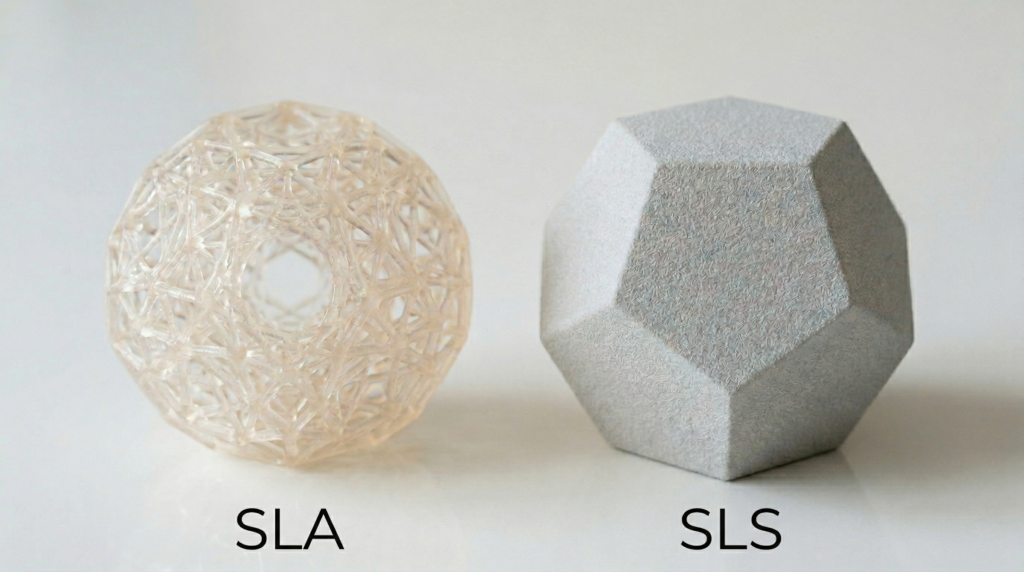
SLA is a 3D printing technology that uses a concentrated ultraviolet (UV) laser to solidify liquid photopolymer resin. The build platform is submerged in a vat of resin, where the laser traces a specific cross-section of the design to cure the liquid into a solid plastic layer. This process is repeated as the platform moves incrementally, creating parts with isotropic mechanical properties and a nearly perfectly smooth surface finish. SLA is widely considered the best choice for applications that require extreme dimensional accuracy and intricate detail, such as dental models, jewelry, and high-detail miniatures.
SLS is an additive manufacturing process that uses a high-power laser to fuse small particles of polymer powder into a solid structure. A recoater blade spreads a thin layer of powder across the build platform, after which the laser traces the cross-section of the object to sinter the material together. One of the greatest advantages of SLS is that the surrounding unsintered powder acts as a natural support, allowing for the creation of highly complex geometries and interlocking parts without manual support structures. Once the print cycle is complete, the part is excavated from the “powder cake” and cleaned, resulting in a durable, functional component suitable for end-use engineering applications.
Both technologies have a similar number of material types available, but they stand out for different reasons. While SLA can provide excellent optical clarity and a wide range of elastic and flexible resins, SLS can offer excellent impact and heat resistance.
Best Use Cases
SLA can be the better option for projects that include:
- High-detail miniatures
- Jewelry, dental and medical models
- Transparent or clear designs
SLS would be the more suitable choice for:
- Small-batch production of functional end-use parts
- Complex interlocking assemblies
- High-performance aerospace and automotive components
Do you want to know how much your model will cost depending on technology and material chosen? Upload it and in a few clicks, have your answer so you can make an informed decision.