
Plastic vs. Metal: When Does Machining Polymer Make More Sense?
When deciding what material to use for your CNC machining project at Craftcloud®, the initial defining factors might be price and strength. But when can a polymer be a worthy alternative to metal?
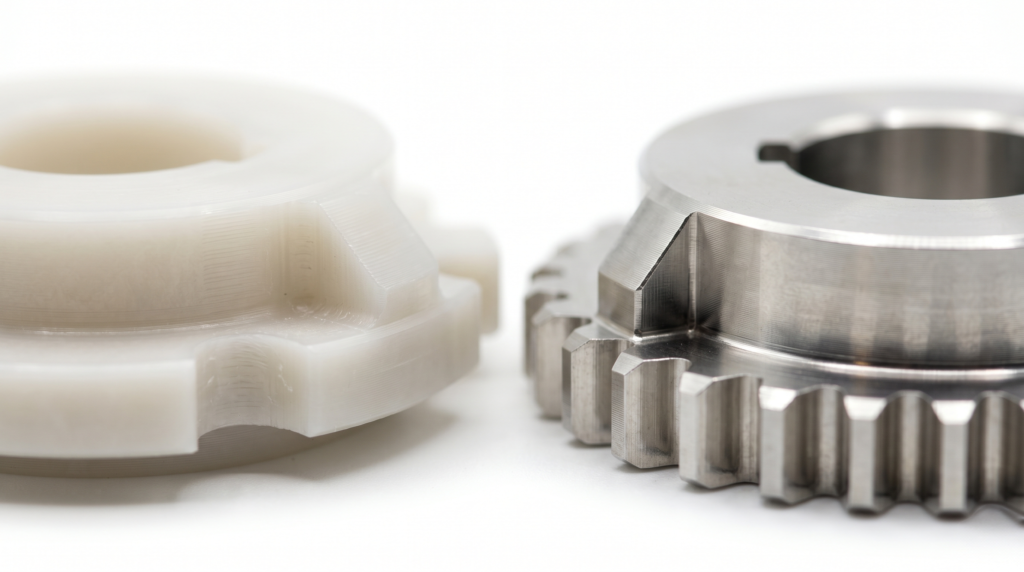
The different metals available for CNC machining purposes provide, among other features, strength and durability. While this is undeniable, it can also come at a cost – more weight, longer lead times, and higher per-part prices.
High-performance polymers, such as PEEK, Delrin® (acetal), or PTFE (Teflon) can be considered as worthy alternatives, especially if the project requires chemical resistance, electrical insulation, or low friction. In addition to plastics being generally more budget-friendly than metals, the efficiencies they allow for in terms of machinability lead to shorter production times and lower per-part costs.
If the project involves electrical insulation, polymers like PEEK and Delrin® (acetal) are natural insulators. For parts that will be exposed to environments with harsh acids, fuels, or constant moisture, many metals will oxidize or corrode (unless post-processed, which can add to the overall lead times and cost). PTFE (Teflon) and Polypropylene (PP) can offer much more durable results, even when compared to steels.
That said, in instances when thermal stability is a must – given that polymers can expand and contract significantly with heat – metal would be more suitable. And if the part is meant to be under extreme mechanical stress, because plastics are susceptible to creep – or a slow deformation under a constant load – metal would provide fatigue resistance.
Depending on the project’s particular characteristics and needs, the usually higher cost of a metal CNC machined part might be unwarranted. Metals can offer a premium feel and can yield more aesthetic parts if anodized, while certain polymers’ standard properties mean that they don’t need post-processing if, for example, they need to be transparent (as is the case of acrylic).
For functional prototyping or bridge production, if the conditions don’t require a metal part, a polymer model could serve as the perfect middle ground between 3D printing and metal CNC machining.
If you would like to know the price of the model for your CNC project depending on material and finish, upload your design and get an immediate quote to move forward in your project!