
SLA Post-Processes Compared
Among the 3D printing services offered at Craftcloud®, Stereolithography (SLA) is a great choice if you are looking to bring to reality high-detail models, jewelry, architectural models, dental appliances, functional engineering assemblies, and more. This additive manufacturing technology also boasts a significant and varied amount of finishes, which may be an additional value or a must for your project.
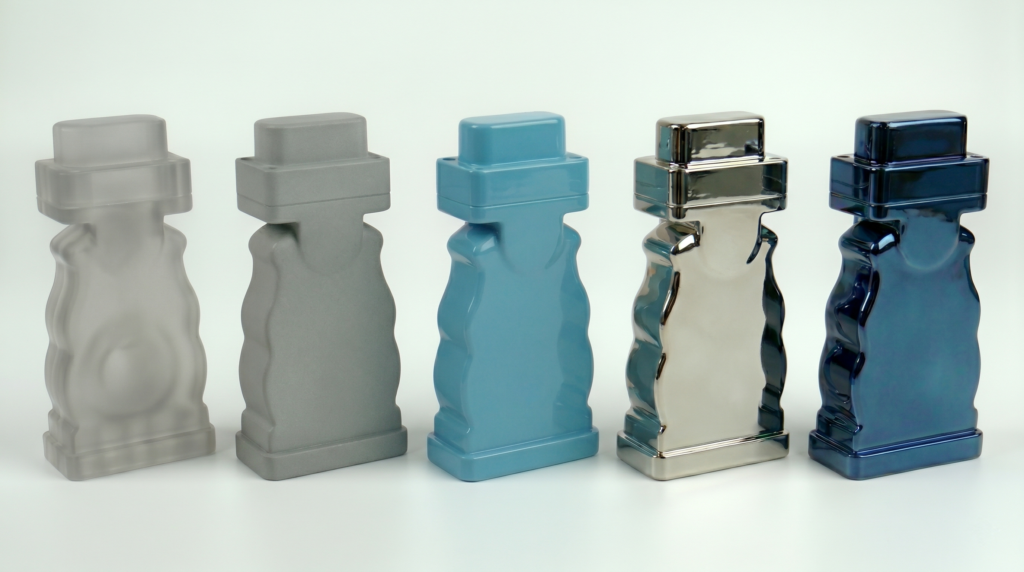
Standard
Because of the way the manufacturing process works, after the model is 3D printed and the supports are removed, it has to be washed and cured to ensure the resin is fully dried. This is the standard finish and is the most accessible option. Depending on support placement, there might be small marks left on the surface.
This might be the only finish option for some materials, like flexible resins, as other post-processing methods can negatively impact the material’s properties. Additionally, if, for example, you’re 3D printing a miniature that you would like to paint, it’s the best finish to avoid losing detail.
Matte
This finish can be achieved in different ways, such as bead blasting or sanding. The surface becomes smoother and will have a matte aesthetic, and it can help remove the already negligible layer lines.
This type of post-processing would be best avoided for high-detail or transparent parts, as they can lose some of the fine detailing and the clarity can be affected. Additionally, the process can lead to flexible and elastic parts to have an uneven or flaky finish, with flexible resins potentially cracking as well. High-wax castable resins should not be post-processed to attain a matte finish, as they can easily deform, while bio-compatible ones would become unsafe for their intended use.
Glossy
Similarly to the matte finish, a glossy option can also be achieved by different processes depending on the specific material and model. Generally, after bead blasting or sanding, the part is covered in a glossy coating. For clear resins, a glossy finish can improve its clarity and help the part achieve transparency.
This option can yield visually aesthetic parts that don’t look 3D printed at all – although almost all the same types of resins negatively affected by a matte finish would also be affected by a glossy finish. Therefore, it would be best to avoid this type of post-processing for said materials.
Electroplated
Electroplating is a process where, in a nutshell, a thin layer of metal is applied to plastic surfaces to enhance durability, corrosion resistance, and electrical conductivity.
Because the process starts with the application of a conductive primer, it would be counterproductive to select it for several types of resins. These include TPU-like, high-wax castable, extremely high-detail, biocompatible or medical resins. In this last case, if the parts are specifically meant to make the most of their ISO 10993 biocompatibility use, electroplating will void that certification.
While it will predictably come at a higher cost than other post-processing options, its aesthetic results and the enhanced properties it will offer might make it ideal for specific end-use cases.
Electroplated Colored
The finish provides a glossy, metallic appearance with vibrant colors, offering enhanced durability, corrosion resistance, and aesthetic appeal for decorative and functional parts.
As with the electroplated option, TPU-like, high-wax castable, extremely high-detail, and biocompatible or medical resins would not be suitable for this type of finish.
This option is, understandably, the most expensive of all – although the results, both aesthetic and in terms of material properties, can be well worth it.