
ScoutDI AS & Craftcloud
ScoutDI shares a bit about how Craftcloud® played a part in the Scout 137’s structure.
Could you tell us a little bit about ScoutDI?
ScoutDI is a Norwegian technology company that develops drone-based systems for fully digitalized inspections of industrial confined spaces. Built around a tethered drone with scanning 3D LiDAR at its core, our Scout 137 platform lets inspectors gather visual, ultrasonic, and 3D data from tanks, pressure vessels, penstocks, and mine workings without anyone entering the asset. We’re headquartered in Trondheim with a team rooted in cybernetics, software, and robotics, and our customers include operators and inspection contractors such as Equinor, Shell, Aker BP, Ørsted, DNV, and TechnipFMC.
How does 3D printing come into play to bring your project to life?
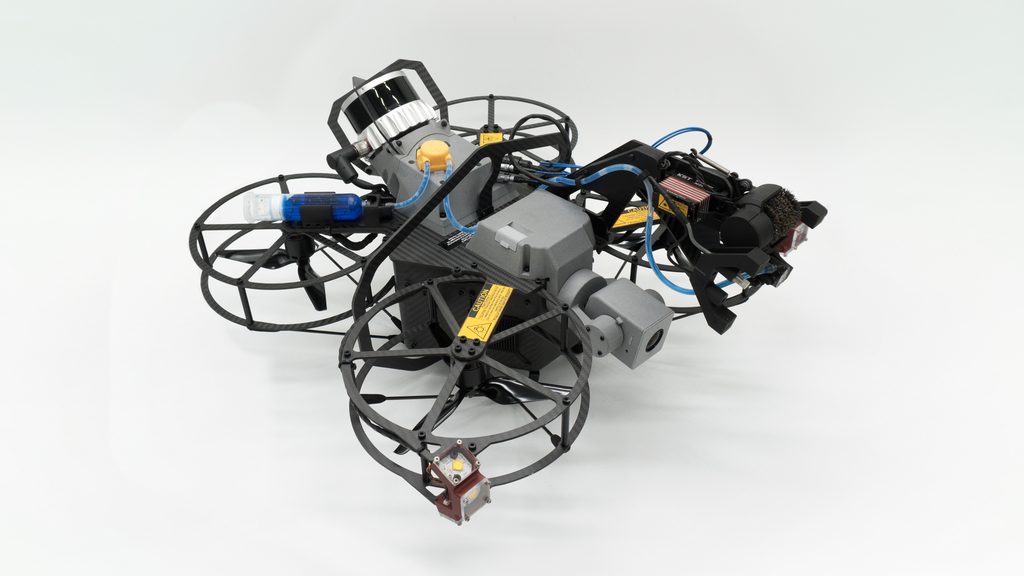
Additive manufacturing is what makes the airframe possible. The Scout 137 packs LiDAR, cameras, lighting, payload mounts, computing, and the tether interface into a very compact, weight-critical structure – every gram of bracketry is a gram less payload. 3D printing lets us design brackets and housings around the optics and sensor cones rather than around tooling constraints, with internal wiring channels and consolidated multi-feature parts. Just as important, it keeps us fast: field feedback can go from revised CAD to production-grade parts in days, with no tooling and no inventory to scrap between revisions.
Which services did Craftcloud provide?
We worked with Craftcloud to access Multi Jet Fusion in HP 3D High Reusability PA 12 FR – a halogen-free, flame-retardant polyamide certified to UL94 V-0 at ≥2.5 mm. The parts are structural and payload-carrying components on the drone airframe, including bracketry for the 128-beam 3D LiDAR. Finishing is the standard MJF pipeline of depowdering and bead blasting, with a GrayShield finish for a clean, uniform appearance on visible airframe parts. These are functional, safety-relevant components that fly inside fuel and chemical storage tanks, FPSO cargo holds, and underground mine workings, so material certification documentation follows each batch.
Are there any benefits working with Craftcloud?
Three things matter to us. First, access: getting a specialized flame-retardant material and a qualified MJF partner through a single route, without running a sourcing exercise for every revision. Second, speed: we can go from a revised CAD file to production-grade parts in roughly four to five working days, with the same finish and documentation each cycle, which is a real advantage when design feedback comes from the field. Third, no tooling: we produce small, demand-driven batches and swap revisions without scrapping inventory. The sustainability profile of MJF, with its high powder reuse, is a welcome bonus.