
|

FDM Post-Processes Compared

At Craftcloud®, you can bring your project to life by choosing between different manufacturing services, including 3D printing. Among the different technologies available, Fused Deposition Modeling (FDM) stands out because of its wide material range, accessible pricing, and (arguably) quick processing times. But FDM is also known for producing parts that show the layer lines of the method. Depending on the material you’re 3D printing, a different finish can be selected to best suit your goals.
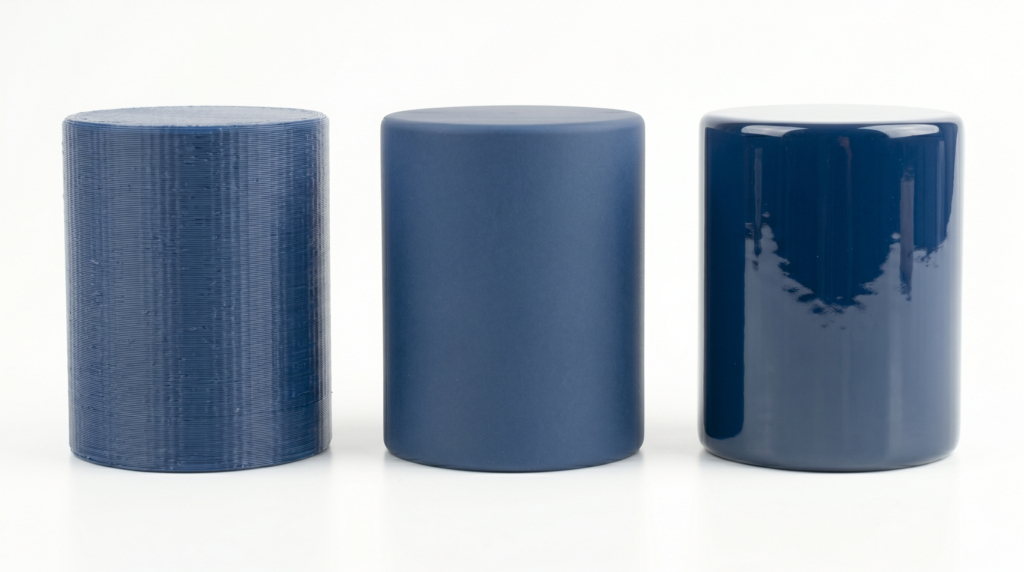
This finishing option is the most budget-friendly, because it means that the 3D printed part is delivered as printed. While supports are removed (if they are needed during manufacturing), no additional post-processing takes place. Layers lines can be visible and there may be some imperfections from supports.

For aesthetic filaments that might be compromised if sanded or polished (such as translucent or silk PLA), this option would be best.

After removing supports, 3D printed parts can be lightly sanded to remove the visible layer lines. That said, it can be less than ideal for models that have very small details that might be eroded as well – or for parts that are meant to interlock with others and have very tight tolerances.

Sanding is a very good finish option if you are then going to paint the print, as the surface will be smoother and can yield cleaner results. That said, if you’re not painting it or further post-processing it, it’s worth keeping in mind that sanding can also affect the color of the filament, making it appear lighter or matte.

This post-processing option isn’t available for all materials, as not all filaments react in the same way to the different agents used. Parts are (usually) first sanded and are then polished – e.g. by buffing – to offer a high-gloss finish.

This is the most aesthetic option, although it does come at a higher price point. Polished parts typically have a mirror-like look, effectively hiding the fact that they were 3D printed at all.

If you would like to see what finishing options are available for your material of choice, check out the Material Guide or upload your file and select the filament that’ll suit your project!

Similar Posts

  • |

    MJF vs. SLA

    Multi Jet Fusion (MJF) and Stereolithography (SLA) are two 3D printing technologies offered at Craftcloud®, each with its own strengths. Do you know which one’s best for your project? The Technologies in a Nutshell MJF is an industrial additive manufacturing process developed by HP® that uses a power-and-fusing mechanism to build high-density nylon parts. A…

  • |

    FDM vs. SLS

    Among the different 3D printing technologies offered at Craftcloud®, Fused Deposition Modeling (FDM) and Selective Laser Sintering (SLS) stand out because of their accessible pricing and complete geometric freedom respectively. But which is more suitable for your project? The Technologies in a Nutshell FDM builds parts layer-by-layer by extruding thermoplastic filament (e.g. PLA, PETG, ABS)…

  • |

    Post-Processing Deep Dive: Bead Blasting vs. Tumble Polishing

    Craftcloud® offers a range of manufacturing services, and among them, CNC machining enables you to create projects with a range of steels, engineering plastics, composites, and more. While many of these materials offer plenty from the start, post-processing can further increase their functionality, durability, and aesthetic finish. Bead blasting and tumble polishing are two of…

  • |

    MJF vs. FDM

    Multi Jet Fusion (MJF) and Fused Deposition Modeling (FDM) are two very different additive manufacturing technologies offered by Craftcloud®. One stands out for the versatility it allows for in terms of geometries, while the other can be very budget-friendly. Which one would be most suitable for your project? The Technologies in a Nutshell MJF, developed…

  • |

    MJF vs. SLS

    Multi Jet Fusion (MJF) and Selective Laser Sintering (SLS) are two additive manufacturing technologies offered at Craftcloud®. They each offer advantages, but which one is more suitable for your project? The Technologies in a Nutshell MJF is an industrial additive manufacturing process developed by HP® that uses a sweeping inkjet array to fuse plastic powder…

  • |

    SLA vs. SLS

    Stereolithography (SLA) and Selective Laser Sintering (SLS) are additive manufacturing technologies offered by Craftcloud®. While they both use lasers in their processes, these differ, and while they can provide high-detail results, each stands out for specific use cases. The Technologies in a Nutshell SLA is a 3D printing technology that uses a concentrated ultraviolet (UV)…