
Weight vs. Strength: When to Use Carbon Fiber Reinforced Filaments
At Craftcloud®, you’ll find a wide range of materials for projects – and this is especially true for Fused Deposition Modeling (FDM) 3D printing. Among the characteristics and features that different filaments have to offer, composites (a base material like PLA or PETG combined with carbon fiber or glass) increase even more what’s possible. When is a good time to select carbon fiber composite filaments?
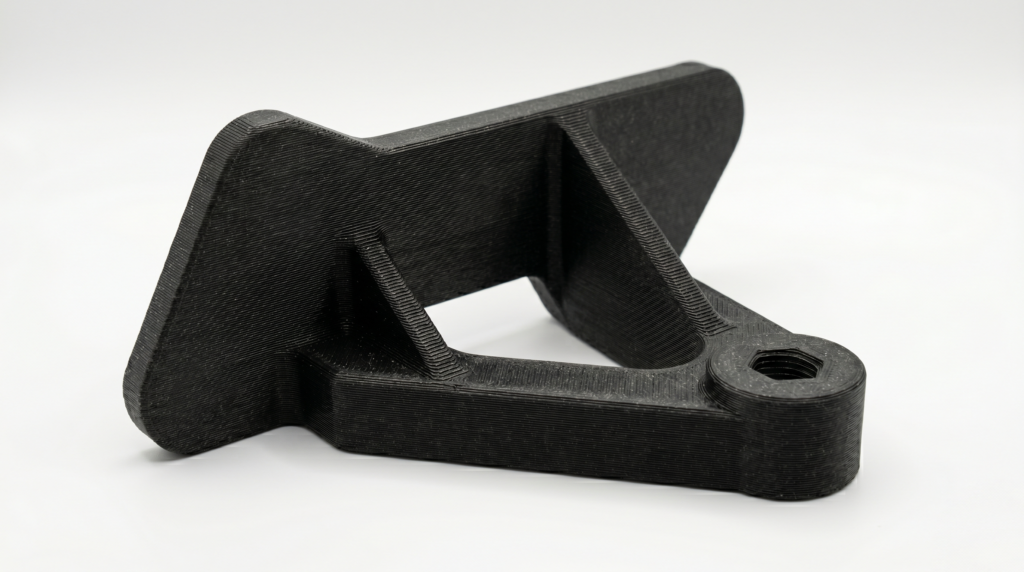
The Combinations
Depending on location and the particular characteristics of your project, you can find carbon fiber (CF) reinforced PLA, PETG, PET, ABS, ASA, nylon (and Markforged® Onyx), PC, PEEK, PEKK, PPA, PPS, ULTEM 9085, and GreenTec Pro.
As these composites have very different base materials, their features will remain distinctive, yet, generally speaking, the carbon fiber reinforcement will make them stronger, more rigid, and will print with a matte finish, hiding layer lines. They will also offer a strategic balance between structural rigidity and mass reduction.
The Benefits
The main reason to opt for a CF composite is to stay within a budget – when other materials or technologies are too expensive – while gaining tensile strength and stiffness. At the same time, because of the base material composition, these parts also remain much lighter than metal counterparts. That said, this isn’t the only advantage of CF reinforced filaments.
The addition also provides an advantage in thermal stability and, additionally, in dimensional accuracy. Especially considering those materials that warp or shrink during the cooling process, such as ABS, nylon, and PETG, among others, the carbon fibers limit the plastic’s thermal expansion, leading to minimal deformation.
Some composites, like CF nylon, can handle much higher Heat Deflection Temperatures (HDT), which makes it an excellent choice for functional prototypes that have to maintain tight tolerances while operating close to high-heat sources.
CF reinforced filaments are worth considering when 3D printing drone frames, automotive brackets, and parts that are exposed to high temperature.
The Drawbacks
The abovementioned benefits do come at a cost, though. First, CF composites are generally more expensive than their base (“pure”) filaments. Additionally, the carbon fibers do lead to an increased brittleness and anisotropy. Because the parts are stiff, they don’t have the same capacity of bending and, under extreme impact, are more likely to snap.
If you are interested in learning about the carbon fiber reinforced filaments available for your project and how they meet your budget, upload your file and get an instant quote.