
Top 10 Materials for High-Heat Engineering Applications
Craftcloud® offers a broad range of materials for CNC machining and 3D printing. If you need high-heat engineering parts, you might want to consider what you can achieve from the different options both in terms of how the material will perform, as well as what shape can be created by each technology.
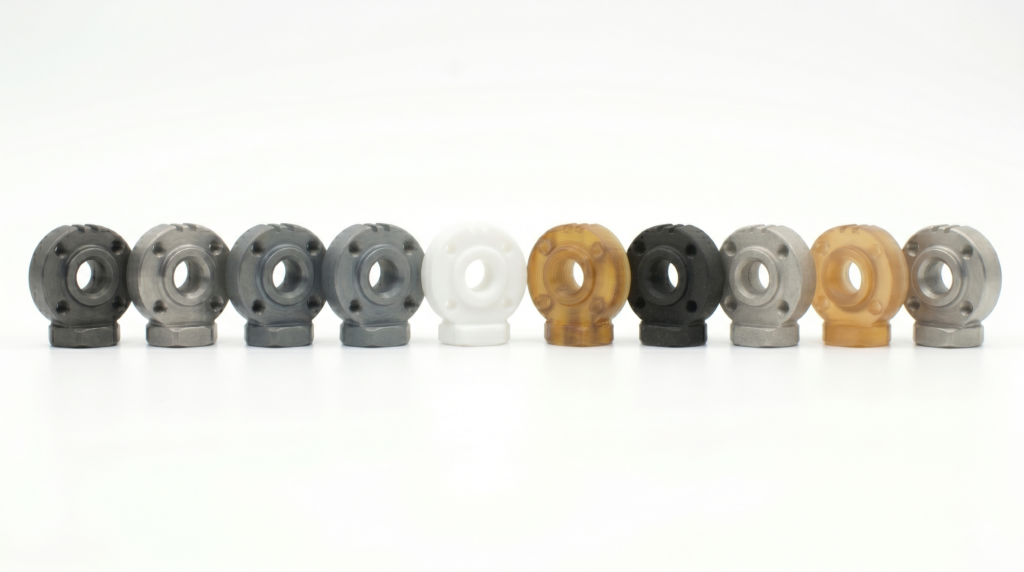
CNC Machining
Because they are carved from solid, high-density blocks, CNC materials are generally better for long-term thermal stability. Among the different heat resistant options, there are a few standouts depending on the specific intended use:
- Titanium (Grade 5) maintains excellent mechanical properties at temperatures up to 400 °C and has a very high melting point.
- Stainless Steel 316L is valued for its oxidation resistance, and it performs well in high-heat environments up to 800 °C.
- Inconel 718 is a superalloy specifically designed for extreme heat, and it retains its strength at up to 700 °C.
- PEEK is the highest-performing CNC plastic. It has a Heat Deflection Temperature (HDT) of around 150 °C if unfilled or up to 280 °C if glass filled.
- PTFE (Teflon) is very stable and chemically inert up to 260 °C – although it’s not as strong as PEEK.
3D Printing
While generally not as strong as CNC machining materials, 3D printing has been evolving and can offer plenty of good alternatives – depending on the final use.
- ULTEM 1010, 3D printed in FDM, has an HDT of 216 °C.
- Carbon Fiber Nylon 12, 3D printed in SLS or MJF, has increased thermal stability due to the addition of carbon fibers to the nylon powder. It can often handle temperatures between 150 °C and 170 °C.
- Aluminum (AlSi10Mg), 3D printed in SLM or DMLS, can remain mechanically stable up to 200 °C.
- High-temperature resin, 3D printed in SLA, can reach an HDT of 235 °C depending on the specific specialized brand. (It’s worth noting that these prints can generally be brittle, so if the part is meant to be under high impact or bending stress at a high temperature, more suitable alternatives would be PEEK or ULTEM.)
- Titanium (Grade 5), Inconel 718, and PEEK, are also available for 3D printing projects, with each reaching an HDT of 400 °C, 700 °C, and up to 250 °C respectively.
If you’re wondering which technology will suit your project’s needs best, read our post on CNC vs. 3D printing, and once you’ve found your answer, upload your file to get an immediate quote!
| Material | Technology | HDT / Service Temp |
| Stainless Steel 316L | CNC | ~800 °C |
| Inconel 718 | CNC, SLM | ~700 °C |
| Titanium (Grade 5) | CNC, SLM, DMLS | ~400 °C |
| PEEK | FDM | ~150 °C (unfilled), ~280 °C (glass-filled) |
| PTFE (Teflon) | CNC | ~260 °C |
| High-Temperature Resin | SLA | ~235 °C |
| ULTEM 1010 | FDM | ~215 °C |
| Aluminum (AlSi10Mg) | CNC, SLM, DMLS | ~200 °C |
| Carbon Fiber Nylon 12 | SLS, MJF | ~160 °C |