
Why FDM Isn’t Ideal for Your High-Detail Models
Fused Deposition Modeling (FDM) 3D printing is a popular choice for Craftcloud® customers because of its wide material range and accessible price point. While under some conditions it can achieve a layer height of 0.08 mm, the average is 0.12 mm. This can (sometimes) be good enough.
However, on specific occasions, an investment on a different technology and material can give way to more satisfactory results that justify the higher price. This can especially be the case of figurines, highly detailed models, and miniatures.
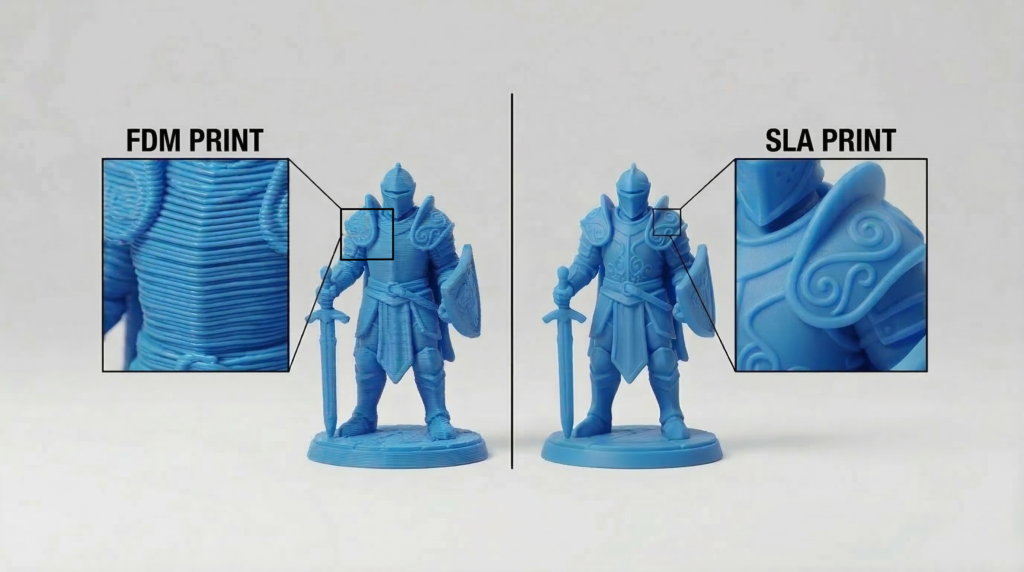
Stereolithography (SLA) is more suitable than FDM because it uses a high-precision laser to cure liquid resin rather than extruding a thick bead of melted plastic. FDM often leaves visible layer lines and rounded edges. SLA, however, can achieve microscopic feature sizes because the laser beam is incredibly fine, allowing for razor-sharp corners and smooth surfaces.
Other resin-based 3D printing technologies like Masked Stereolithography (MSLA or LCD) and Digital Light Processing (DLP) are also top contenders for high-detail models. These can reliably provide layer heights as low as 0.01 to 0.05 mm, and while not as wide, also offer a significant range of materials. While these technologies, along with SLA, can be slightly more expensive than FDM (generally speaking), they are a way of achieving much finer detail at a still budget-friendly price point.
SLS is a great choice specifically when it comes to organic or highly complex geometries that need internal supports. In FDM, complex overhangs require support structures that have to be broken off, often leaving marks on the model’s surface. SLS uses a bed of self-supporting powder; as the laser fuses the nylon, the unsintered powder holds the part in place. This allows for the creation of intricate “ship-in-a-bottle” designs, interlocking gears, and thin-walled lattices.
MJF offers a massive leap in detail and consistency over FDM by using an inkjet-like printing head to apply fusing agents across a powder bed. While FDM builds a part layer by layer, MJF processes entire layers at once with high-resolution thermal imaging. This results in much higher “isotropic” strength – meaning the part is equally strong in all directions – and much finer dimensional accuracy. Because the heat is more controlled, MJF parts don’t warp or shrink as easily as FDM parts.
Read more about the best options for your figurines, highly detailed models, and miniatures in our Knowledge Base & Help Center before you upload your file(s) and compare the price of your model in different technologies and materials.