
CNC vs. 3D Printing: When Should You Choose Either?
CNC machining and 3D printing are two different manufacturing methods: the former is subtractive, the latter is additive. This means that with CNC, you start from a block of material and you mill or turn away the excess until you finish with the design. With 3D printing, depending on the specific technology, a base material is heated or lasered layer by layer to form a final model.
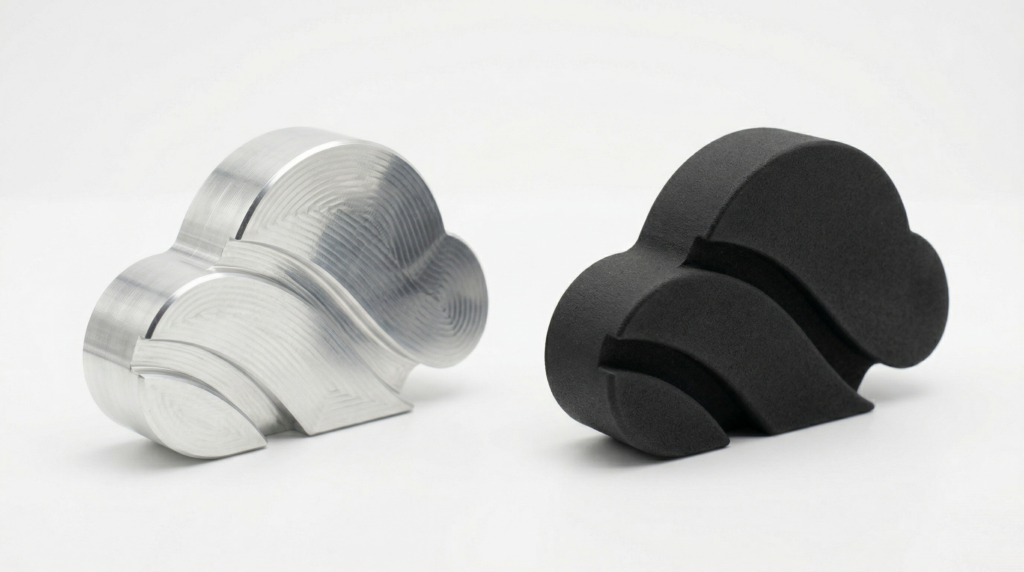
Craftcloud® offers both CNC and 3D printing services (as well as sheet metal fabrication and casting and molding). Each manufacturing method has different benefits, so depending on your project’s scope, you might want to consider how they will address your needs.
Because 3D printing is an additive process and you’re starting with an empty build plate – be it through FDM, SLA, MJF, or other technologies – you can create more complex geometries, especially for internal structures. Additionally, the wider material range, from thermoplastics and composites to nylons and engineering resins, means that you have more options and post-processing finishes available. If you’re a bit pressed for time, 3D printing can also be the better option. This is because, overall, the whole process can be much faster, from designing through 3D printing and post-processing (as necessary).
While 3D printed parts can be strong and durable – especially when opting for high infill and determined materials – CNC machined parts are arguably more durable by default. Plus, because of the technical aspects of the process, it allows for a more accurate dimensional accuracy and tighter tolerances, with a standard ±0.125 mm. For larger parts, because there is no build plate limiting the size of the creation, CNC machining can offer more volume. And depending on the material, CNC machining can be more suitable for industrial use given the impact-, heat-, and chemical-resistance of milled or turned parts.
3D printing can be better if your project includes:
- Topology-optimized brackets
- Parts with internal lattice structures
- Hollow spheres
- Print-in-place assemblies
- High-detail miniatures and jewelry
CNC machining could be the right decision when it comes to:
- Engine pistons and cylinders
- Bolts, shafts, and screws
- Flat mounting plates
- Heavy-duty tooling
- Thin-walled aerospace frames
Once you have a clearer idea of which path might be most suitable, you can upload your file and see what the different options mean in terms of pricing.