
MJF vs. SLS
Multi Jet Fusion (MJF) and Selective Laser Sintering (SLS) are two additive manufacturing technologies offered at Craftcloud®. They each offer advantages, but which one is more suitable for your project?
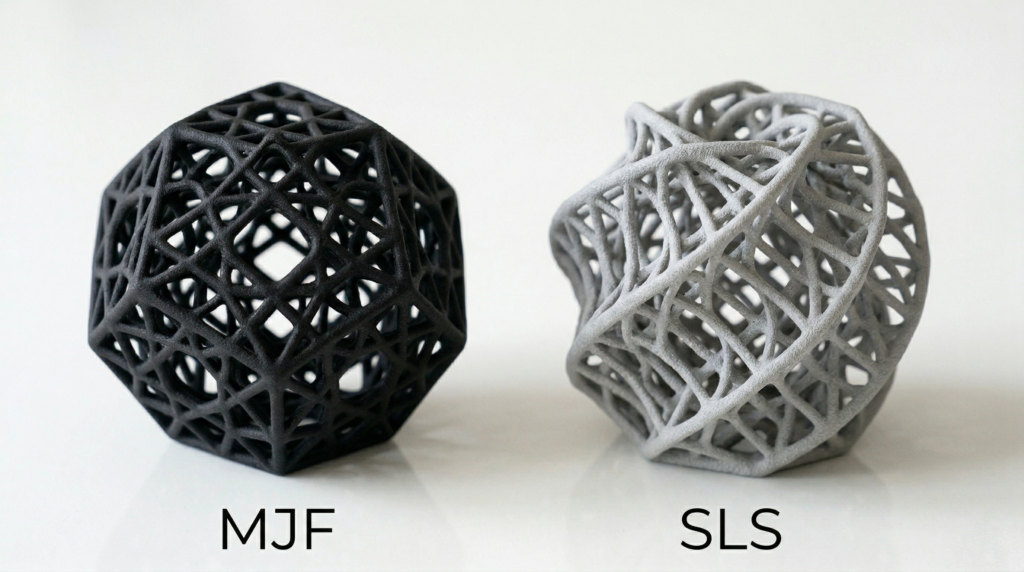
The Technologies in a Nutshell
MJF is an industrial additive manufacturing process developed by HP® that uses a sweeping inkjet array to fuse plastic powder into solid parts. After spreading a thin layer of material across a build bed, a fusing agent is selectively applied to the cross-section of the part. High-power infrared lamps then pass over the bed to melt the areas treated with the agent, while a detailing agent ensures sharp edges and smooth surface finishes. Because the surrounding unsintered powder acts as a natural support, MJF allows for the creation of highly complex, interlocking geometries without the need for manual support structures.
SLS is a powder-bed fusion technology that uses a high-power CO2 laser to sinter small particles of polymer powder into a solid structure. A recoater blade first spreads a thin, even layer of powder across the heated build platform before the laser traces and fuses the specific geometry of each layer. Like MJF, this process is self-supporting, meaning that the surrounding “powder cake” holds the part in place, enabling the production of intricate designs and moving assemblies. Once the printing is finished, the parts are cooled and excavated from the bed, resulting in durable, isotropic components that are ideal for functional engineering applications.
When it comes to materials, SLS (currently) supports a slightly wider variety of specialized options – like TPUs and glass-filled polymers. As for finishes, MJF parts typically have a slightly smoother appearance in their standard form while SLS parts have a grainy, matte texture (unless they are post-processed).
Best Use Cases
MJF could be the better choice for your project if you are interested in:
- High-volume functional part production
- Complex ducting and lightweight lattice structures
- Movable, print-in-place assemblies
SLS would be more suitable for:
- Small-batch production of functional end-use parts
- Durable jigs and fixtures
- High-performance aerospace and automotive components
Do you want to know how much your model will cost depending on technology and material chosen? Upload it and in a few clicks, have your answer so you can make an informed decision.