
Castable Resin, Castable Wax, and Castable Wax Resin for Investment Casting: Which One Is Right for You?
Investment or lost-wax casting is a manufacturing process that is used to produce highly detailed metal parts, from jewelry to aerospace components. While castable resin, castable wax, and castable wax resin are all designed for it, choosing the wrong one can lead to a failed project.
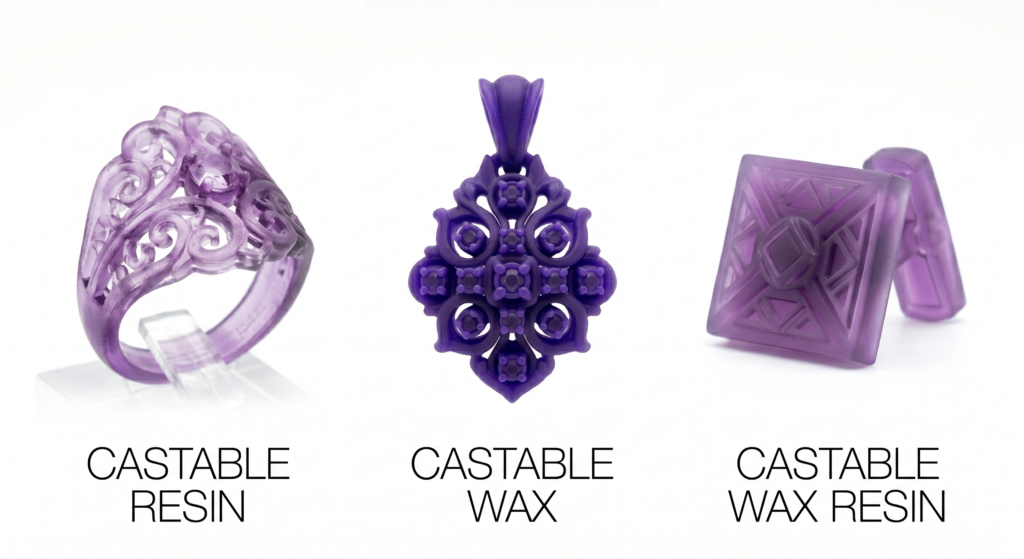
When it comes to investment or lost-wax casting, in a nutshell, a highly detailed 3D pattern is 3D printed via SLA, DLP, or LCD. This print is then encased in a ceramic-like plaster slurry and the mold is placed in a high-temperature kiln. The plastic or wax is completely burned away and leaves a hollow cavity, which is then filled with molten metal to create the final metal part.
Castable resin doesn’t include any wax in its composition, and it offers exceptional structural strength. However, it requires rigorous, high-temperature burnout schedules in order to avoid thermal expansion, which can leave behind ash in or crack the ceramic mold.
Castable wax refers to solid or liquid wax filaments with no ash content, which translates to it melting away without leaving any markings or blemishes. That said, because of its material composition, it is very fragile and can’t always handle fine wire filigrees or thin prongs easily without breaking during post-processing.
Castable wax resin is a photopolymer with 20%-40% liquid wax, and it prints with the precision of resin while burning out cleanly like wax. These advantages do come at a higher price point, and the material is optimized for smaller, highly intricate geometries rather than larger pieces.
For a complete workflow, when working on the prototyping phase of the project, opting for standard resin to verify the part’s fit, scale, and ergonomics, can also be a useful way of keeping costs lower before beginning the more expensive casting process.
Best Use Cases
Castable resin can be the right choice if your project includes:
- Industrial brackets
- Thick-walled components
- Large sculptures
Castable wax could be better suited for:
- Heavy signet rings
- Thick metal hardware and emblems
- Traditional industrial casting patterns
Castable wax resin might be the better option for:
- Fine jewelry with delicate filigree
- Dental crowns and bridges
- Intricate stone prongs and pavé settings