
316L Stainless Steel vs. AlSi10Mg Aluminum: Strength vs. Weight
When it comes to both metal 3D printing and CNC machining, 316L Stainless Steel and AlSi10Mg Aluminum are among the most popular and sought after options. Why is this and which one would be most suitable for your project?
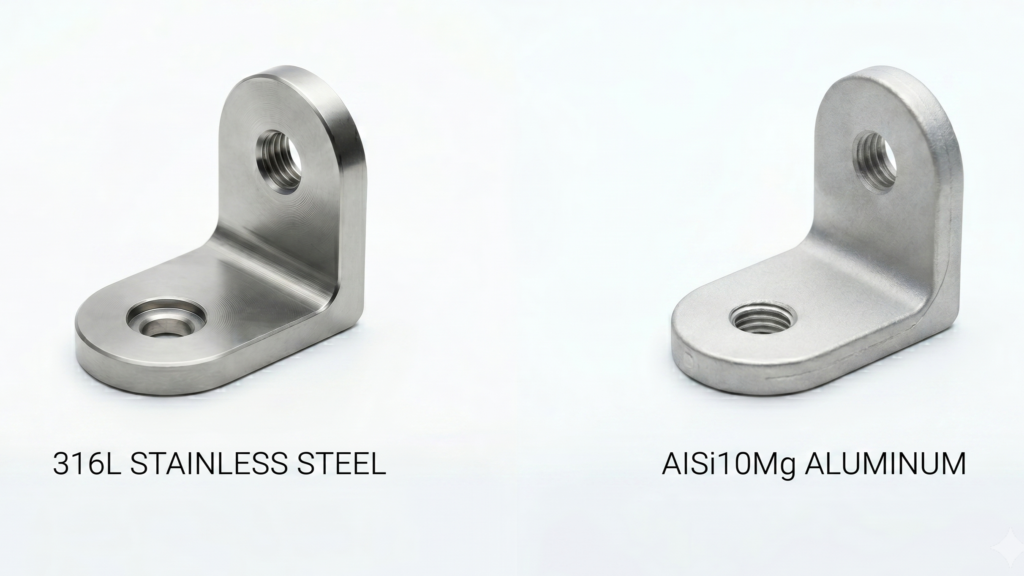
Metal 3D printing and CNC machining are, in a nutshell, opposite ways of manufacturing: Where the former is additive, the latter is subtractive, and that’s the first of the many differences. However, some materials overlap as they are available for both types of manufacturing, and 316L Stainless Steel and AlSi10Mg Aluminum are such an example.
Metal 3D Printing
Because of the technology – Laser Powder Bed Fusion (LPBF/DMLS) – intricate geometries and structures can be created in either material.
That said, 316L Stainless Steel is known for its significant tensile strength, high ductility, and resistance to harsh chemical environments. When the material is 3D printed, it is suitable for high-stress, high-impact applications. Because it is a high-density material, though, 316L Stainless Steel can be too heavy for applications where weight is critical for performance.
AlSi10Mg Aluminum is, on the other hand, low density, while it still delivers an excellent strength-to-weight ratio and significant tensile strength. In addition to its lightweight nature, it provides thermal and electrical conductivity, although it can’t offer the same chemical resistance and overall hardness of 316L Stainless Steel.
CNC Machining
This manufacturing method starts from a solid block of either material, and the higher dimensional accuracy and tighter tolerances make it a better choice for parts that require these.
No matter what the manufacturing method is, 316L Stainless Steel provides high chemical resistance and an even higher tensile strength. That said, because of its higher density, the machining itself might become more expensive because of additional tool wear.
AlSi10Mg Aluminum, generally speaking, can be more budget friendly due to its faster machining time and higher abundance and accessibility. Because the material is “soft”, it can be machined faster, while 316L Stainless Steel requires slower machining cycles because it’s more tough and abrasive. Like its 3D printed version, it is also an excellent thermal conductor.
Best Use Cases
316L Stainless Steel is generally more suitable (depending on the manufacturing technology) for:
- Marine tools
- Surgical tools
- Fluid manifolds
AlSi10Mg Aluminum can be the better material for the following cases, although this might also be affected by the fabrication method:
- Machined electronic enclosures
- Heat sinks
- Automotive brackets and housings