
Titanium vs. Inconel 718: Choosing a Material for Extreme Environments
When it comes to metal 3D printing and CNC machining, two materials that stand out for their mechanical properties are Titanium and Inconel 718. These are ideal for parts that will be exposed to extreme environments, but how do they compare and which one is more suitable for your project?
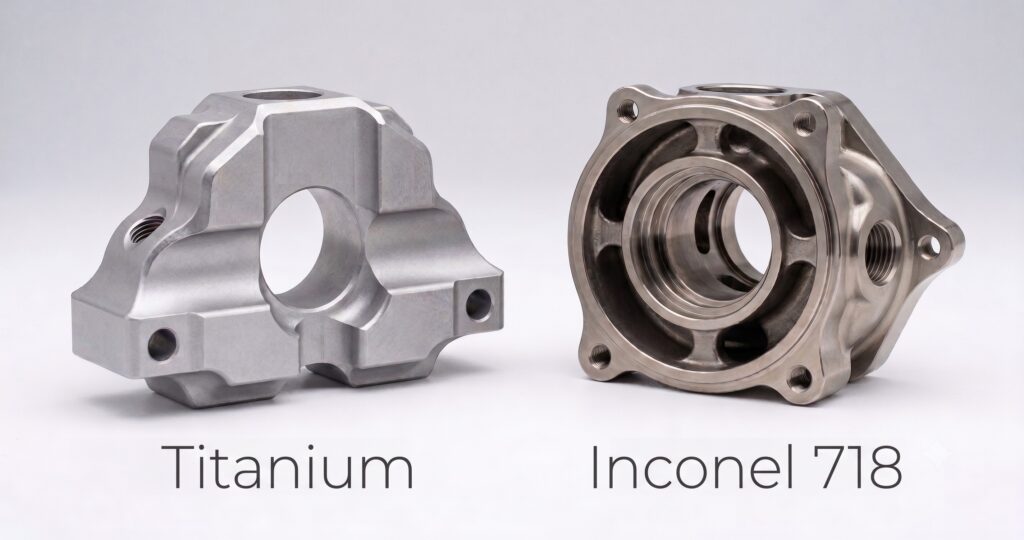
Titanium (typically Ti-6Al-4V Grade 5) and Inconel 718 can both be 3D printed via DMLS/SLM or CNC machined. Because of the different nature of the manufacturing processes – 3D printing is additive while CNC machining is subtractive – a variety of considerations come into play depending on the intended use case for each material.
Metal 3D Printing
Laser Powder Bed Fusion (LPBF/DMLS) allows for the creation of intricate geometries and structures in both materials.
Titanium has the highest strength-to-weight ratio of any metallic element, and it is the arguably best choice for structural aerospace brackets, drone frames, and racing chassis where weight of the part is key. In addition to its lightweight characteristic, Titanium affords an excellent corrosion resistance against saltwater and aggressive chemicals, and it is also non-toxic and biocompatible. The main caveat about Titanium 3D printed parts is that the material’s mechanical strength starts to degrade once it’s exposed to temperatures over 400 °C.
Inconel 718, a nickel-chromium-based superalloy, is engineered to withstand much higher thermal and corrosive environments. It can maintain its structural integrity and oxidation resistance at temperatures up to 700 °C. This thermal stability makes the material the industry standard for rocket engine combustion chambers, exhaust manifolds, and gas turbines. The higher thermal resistance comes at a cost of a higher density.
CNC Machining
Starting from a solid block of the material, this manufacturing method provides tighter tolerances and higher dimensional accuracy. Both materials are notoriously difficult to cut because of their low thermal conductivity, which can lead to higher prices from frequent tool replacements or slower cycle times.
The same weight-to-strength ratio from 3D printing Titanium Grade 5 stands for its CNC machined state. The material also affords excellent dimensional stability, which allows CNC lathes to cut precise, tight tolerances for threads and mating surfaces. The mechanical properties, as with the 3D printed option, also flounder at around 400 °C.
Inconel 718 , machined from a solid block, offers excellent fatigue resistance. The not insignificant downside is the material’s weight and cost, as it is almost twice as dense as titanium and needs especially rigid CNC setups and tools.
Best Use Cases
Titanium Grade 5 can be the better choice (depending on the manufacturing technology) for:
- Aerospace brackets
- Medical implants
- Sports hardware
Inconel 718 could be the more suitable option for any of the following use cases, although this might also depend on the manufacturing method:
- Rocket nozzles
- Turbine blades
- Exhaust manifolds