
Sheet Metal Finishings Compared: Powder Coating, Anodizing, and Plating
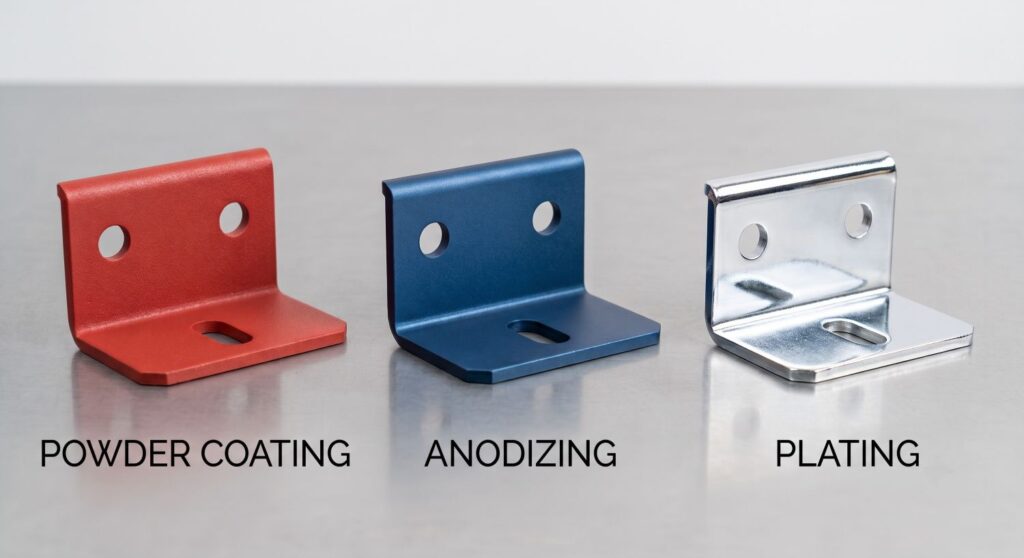
Sheet metal fabrication, one of the manufacturing services offered at Craftcloud®, involves four processes: cutting, forming, joining, and finishing. Each of these, in turn, comprises of different possibilities. When it comes to finishes that can protect from corrosion or add aesthetic appeal, powder coating, anodizing, and plating offer different benefits to the produced parts.
Powder Coating
Generally speaking, powder coating refers to applying a dry polymer powder electrostatically to the metal sheet, and then curing the part in an industrial oven. This leads to a thick, hard coat that is resistant to fading, scratching, and chemical wear. Because of the materials and process involved, powder coating offers a wide range of colors, gloss levels, and even different textures, such as matte, glossy, or wrinkled.
It’s worth noting that, because it adds a layer of thickness (usually 50 to 150 microns), parts meant for tight-fitting assemblies need to factor this into the tolerance calculations.
Parts that benefit from powder coating include outdoor and weatherproof enclosures, electrical and industrial equipment housings, and industrial frames exposed to oils, solvents, or impact.
Anodizing
In a nutshell, anodizing electrochemically transforms the surface of the base material – most commonly aluminum – so that it becomes a corrosion-resistant oxide layer. This is integrated with the metal and increases the surface hardness and wear resistance. Additionally, it acts as an electrical insulator, and allows for the anodized parts to be dyed with a wide range of colors.
The arguably limiting factor is the material compatibility, as it is used exclusively with non-ferrous metals.
Anodizing is a suitable choice for electronics enclosures, industrial and aerospace components exposed to friction, and architectural panels and facades that have to resist weather-driven corrosion.
Plating
This finishing process covers several options, such as zinc, nickel, and chrome plating, where a thin layer of a secondary metal is deposited on the sheet metal surface via an electroplating bath or a chemical reaction (electroless plating). Zinc plating provides cost-effective corrosion resistance and is widely used on steel. Electroless nickel plating offers a highly uniform thickness with excellent wear resistance. Chrome plating delivers a hard, mirror-like finish with low friction and strong corrosion protection.
Plating costs vary depending on the method and material used: Standard zinc electroplating is usually the most economical option at scale, while specialized electroless nickel or hard chrome plating can carry a higher price tag.
Plating parts can be a good option for stamped brackets and steel panels, complex-geometry parts that need uniform coverage, and decorative and wear-critical automotive parts.