
Understanding 3-Axis, 4-Axis, and 5-Axis Milling
CNC machining is a subtractive manufacturing process where material is carved away using rotating tools that move along various paths. Choosing the right configuration – 3-axis, 4-axis, or 5-axis – is a balancing act between the complexity of your part, the required precision, and your budget. Understanding these differences is essential for engineers and designers who are looking to optimize their workflow and achieve the perfect finish on high-performance components.
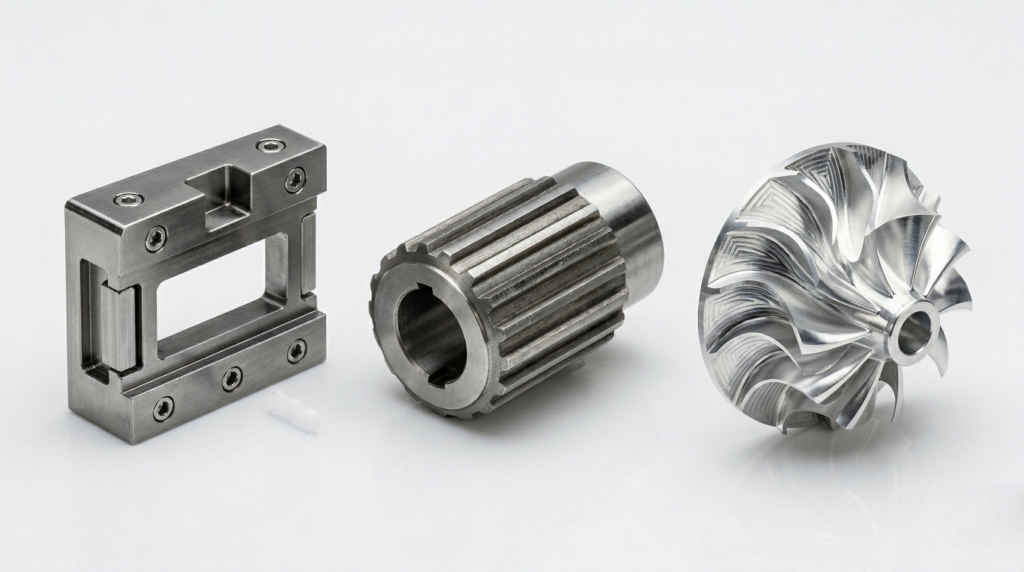
3-axis machining is the most common and straightforward form of CNC milling, where the cutting tool moves along the traditional X, Y, and Z linear axes. This setup is ideal for mechanical parts with relatively flat profiles or simple geometries, as the tool can only reach the workpiece from a top-down orientation.
To bridge the gap toward higher complexity, 4-axis machining adds a rotation around the X-axis (known as the A-axis). This allows the workpiece to be flipped or rotated automatically, enabling the tool to cut along the sides of a part or create cylindrical features without the need for a human operator to manually reposition the material.
For parts that require organic curves or intricate internal features, 5-axis machining represents the gold standard of subtractive manufacturing. In addition to the standard X, Y, and Z movements, a 5-axis machine uses two additional rotational axes (typically B and C), which allow the cutting tool to approach the workpiece from virtually any direction simultaneously. This “simultaneous” movement means that the tool can maintain an optimal perpendicular angle to the part’s surface at all times, resulting in a superior surface finish and the ability to carve deep undercuts or complex impellers. While the programming and machinery are more expensive, 5-axis milling significantly reduces setup time and eliminates the cumulative errors that occur when a part has to be moved between multiple machines.
Which Is Right for Your Project?
3-axis CNC machining is most suitable for parts that are relatively flat and which can be finished from a single top-down direction. Examples include:
- Mounting plates and brackets
- Manifolds and valve bodies
- Enclosures and housings
- Molds and dies
4-axis CNC machining is best suited for cylindrical parts or components that have features on multiple sides around a central axis. Such parts can be:
- Crankshafts
- Cylindrical housings
- Geras and splines
- Simple turbine blades
5-axis CNC machining would be most adequate for complex, “organic” geometries where the cutting or milling tool has to access the part from any angle. Some examples are:
- Impellers and inducers
- Aerospace structural components
- Medical implants
- High-end automotive engine blocks
Are you ready to start your CNC machining project at Craftcloud®?